
Blind & Low-Vision Community

A blind dating app built for voices, not photos

Mainstream dating apps are photo grids with a chat button bolted on. That's a problem when the photo was never the point. Modern Dating is a blind dating app where voice intros, rich profile text, and screen reader support are the defaults - not a checkbox buried in settings. Meet people who want to hear you before they see you.

See How It Works

Free forever. Screen reader tested. Zero image-only profiles.

Totally blind Low vision Legally blind Late-onset vision loss Guide dog users
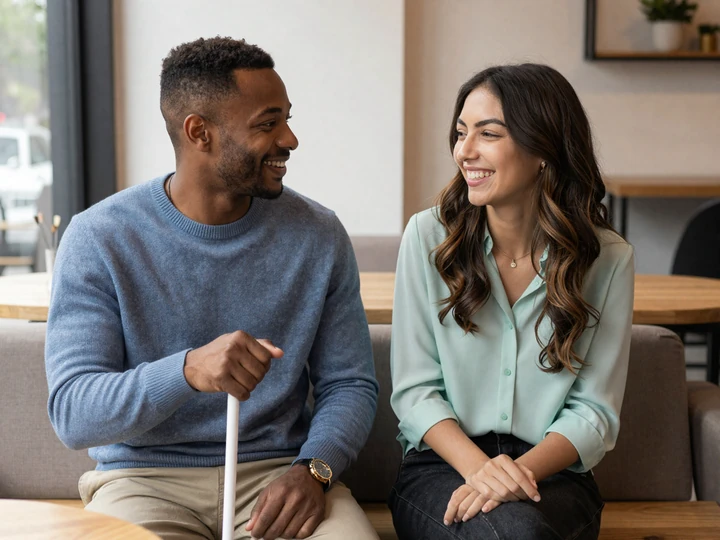
Blind man using a white cane and his sighted partner laughing together on a café bench - voice-first blind dating app community
Voice intros first Hear, then decide
Screen reader tested NVDA, JAWS, VoiceOver
Large text everywhere Up to 200% zoom
Verified profiles Scams removed fast
Why this exists

Visually impaired dating shouldn't start with a photo grid

The main barrier on mainstream apps isn't bias from other users. It's the interface itself.

Tinder, Hinge, and Bumble are built around photos and short video clips. A screen reader can announce that an image exists, but if the sighted user didn't write a caption - and most don't - the screen reader has nothing to read. A profile becomes a row of silent image tags and a one-line bio. For blind and low-vision daters, that's not a profile. It's a closed door with a polite "image" label on it.

The workarounds get old fast. Asking every match to describe themselves. Hoping a friend has a free hour to read profiles aloud. Giving up on a promising conversation because navigating the payment screen with VoiceOver turned into a thirty-minute puzzle. None of this is the user's failure. It's a design choice made by teams who never tested with assistive technology before shipping.

Modern Dating starts from the opposite assumption. Every profile has a voice intro, every image has alt text, every button has a label a screen reader can announce. The platform reads well whether your eyes are on the screen or not. That's what a real blind dating app looks like - not a mainstream app with an accessibility statement glued to the footer.

If you're new to the wider inclusive dating world, our accessibility in dating guide covers the full picture, and inclusive dating advice lays out ten principles that apply across every community here.

The core idea

Voice-first dating, not photo-first judging

Text can't carry calm, warmth, or a good laugh. A photo can't tell you whether someone is kind. A voice can do both in under thirty seconds.

Voice does what photos can't

A voice intro is the shortest honest route to a first impression. You hear tone, pacing, humor, nerves, patience. You hear whether someone smiles when they talk. You hear whether they rushed or took a minute. Visually impaired daters don't need these cues as a workaround - they use them because voice is genuinely richer than a curated photo reel.

On Modern Dating, every new member is invited to record a thirty-second voice intro during signup. It's optional, but about four out of five members add one. Messaging supports voice notes up to two minutes, and video chat offers audio-only mode by default. Nobody is pressured to show their face, ever.

For sighted partners and allies, the voice-first approach becomes surprisingly addictive. You start skimming profiles with the audio on instead of scrolling through photos. You make better decisions about who to message. The whole experience slows down in a good way.

30-second intros Voice messaging Audio-only video

What a voice intro sounds like

“Hi, I'm Marcus. I've been totally blind since birth, I live in Chicago with a golden retriever named Biscuit, and I run a small podcast about jazz history. If you laugh easily and don't mind a man who narrates his own grocery list to the dog, we'll probably get along.”

What this tells a potential match in 22 seconds: warm tone, clear diction, good-humored, specific interests, upfront about blindness without making it the whole identity, and a sense of home life. No photo could do that.

What the other person hears matters too

Voice isn't just a self-portrait - it's a filter. The people who reply to a voice intro are usually the ones who listened, not the ones who scrolled. Conversations that begin that way tend to go deeper, faster.

Built for screen readers

Screen reader accessibility, not an afterthought

Tested with NVDA, JAWS, and VoiceOver on every release. Every button has a label. Every image has alt text. Every form tells your screen reader what it wants.

Alt text on every image

Profile photos, hero images, icons - everything on the site carries a written description your screen reader will announce. Members who upload photos are prompted to add a short description before posting. "Image" as a label is not allowed here.

Descriptive alt textNo empty labels

Keyboard navigation throughout

Tab through the whole site without a mouse. Focus rings are visible, skip-to-content links are in place, and no critical action is locked behind a hover-only menu. Menus, filters, and the messaging inbox all work from the keyboard alone.

Full keyboard supportVisible focus

Voice profile readings

Every written profile field can be played back as natural-sounding audio, not just screen-reader output. Useful when your assistive tech is busy, when you want to listen on the go, or when you prefer a second voice reading long bios aloud.

Audio playbackNatural voices

What accessibility means in numbers

  • Text scales to 200% without layout breaking or content getting cut off.
  • Color contrast meets WCAG 2.2 AA across light and dark modes, with high-contrast mode available in one tap.
  • Every form field is labeled, every error is announced, every required field is clear before you submit.
  • ARIA landmarks for header, navigation, main, and footer so screen readers can jump by region.
Make your profile work

Profile advice for blind and visually impaired daters

Five moves that consistently bring better matches. They play to the strengths of a voice-and-text platform instead of fighting them.

  1. Record the voice intro early

    A thirty-second intro outperforms a photo every time on this platform. Say your name, one specific thing you love, one specific thing you're looking for. Don't script it perfectly - a little warmth beats a polished pitch. You can re-record as many times as you want.

  2. Write descriptive bio fields, not clever one-liners

    Platforms for the visually impaired lean on rich text because text is the shared language. Fill out the personality, interests, and "a typical Sunday" fields in full sentences. Match partners use these fields the way sighted daters use photos - to picture who you are.

  3. Include practical physical details if you want to

    Height, hair color, eye color, body type, style of dress - many blind and low-vision daters appreciate these in the profile because a sighted match can't easily describe them on request. Keep it optional. Skip anything that feels reductive.

  4. Name the vision level in your own words

    "Totally blind since age six," "low vision, can read large print," "light perception only" - specific beats vague. It saves awkward twenty-questions conversations later and attracts people who already know what it means. Sighted allies especially appreciate the clarity.

  5. List your accessibility preferences upfront

    Do you prefer voice notes to text? Quiet cafés over loud bars? FaceTime with audio-only for first video calls? Put it in the profile. Nobody minds - most people are relieved to know.

Your timing, your choice

When and how to share about your vision

Some daters mention blindness in the first line of the profile. Others wait until a third date. Both are fine. What matters is that it feels like a choice.

Disclosure timing for vision loss is personal. There's no universally correct moment to bring it up, and anyone who tells you otherwise is guessing. The two general patterns work for different reasons.

Early disclosure - in the profile or the first message - filters fast. The people who reply are the people who are already comfortable with it. You skip the awkward middle where a great conversation hits a wall because a sighted match "didn't realize." Many late-diagnosed daters and guide dog users prefer this approach because it sets the tone from minute one.

Later disclosure - a few dates in, or once real trust has started - keeps the first impression focused on personality. You meet as two people first, disability second. This works well for daters who are tired of blindness being the first and loudest fact about them.

Sample scripts that make it easy

In the profile, low-key: "I'm totally blind - happy to answer questions when they come up. Much more interesting topics include my unreasonable love for cold soba noodles."

First message, casual: "Quick heads-up before we go further - I'm legally blind, use a cane, and prefer voice notes to long texts. Not a big deal, just want you to know."

In person, mid-conversation: "One thing I wanted to mention - my vision works differently than yours. I can see shapes and some color but not faces. Feel free to describe things out loud if you think I'd like them."

A note on practical language over labels: many daters find it easier to describe what they need ("I'll ask the server to read the menu aloud") than to lead with a diagnosis. Both are valid. The goal is less performance, more plain conversation.

Safe and sensible

Safety practices that make sense

Choosing an accessible meeting place is a strength, not a limitation. So is taking the time you need before meeting in person.

Build trust before meeting

Exchange voice notes for a week or two before planning a date. Tone tells you more than any amount of texting. If something feels off, trust it - voice catches the things typed words hide.

No rush

Use verified profiles

Filter for the blue verification badge when browsing. Verified members completed a selfie-plus-audio check that's hard to fake. Most scams and fake profiles never get verified, and that alone cuts a huge percentage of risk.

Verified badge

Choose familiar, quiet places

First meetings work best in spots you already know: a café you've been to with friends, a park bench near a main road, a library reading room. Familiar geography means you know the exits, the acoustics, and how to get home.

Known venues

Share plans with a person you trust

Tell a friend or family member where you're going, who you're meeting, and when you expect to be home. A simple check-in text at the end of the date closes the loop. This is standard for all daters, not just blind ones.

Check-in system

Read the full online dating safety guide

Date ideas

Virtual and in-person date ideas

Six formats that work for blind, low-vision, and mixed-sight couples. Audio-rich, conversation-forward, low-friction.

Virtual museum audio tours

Many major museums offer free audio descriptions of their collections. Pick one together, hit play at the same time, and talk over it like a shared podcast. The Met, the Smithsonian, and Tate Modern all have strong audio catalogs.

Audio toursVirtual

Accessible online games

Battleship, chess with accessible apps, trivia games with voice input - low-vision-friendly games on the market have grown fast. Keep it short the first time. One round is plenty for a first date.

BattleshipTrivia

Cook the same recipe together

Pick one simple recipe, shop separately, cook at the same time on a video call with audio-only mode. Narrate what you're doing. Laugh at the parts that go wrong. Eat together on the call. It lasts about ninety minutes and feels like a real date.

Cook-along

TED Talks or podcast and react

Choose a 15-minute talk or episode. Listen together. Spend the next half-hour talking about what you agreed with and what you didn't. Low-pressure, intellectually honest, and a good read on someone's thinking style.

Shared listen

Quiet café or bookshop afternoon

In person, pick a bookstore with a café or a quiet independent coffee shop. Good acoustics, easy orientation, no deafening music. Great first-date environment whether one or both of you use a cane or guide dog.

Familiar venue

Guided sensory walks

A slow walk through a botanical garden, a park with birdsong, or a neighborhood with good food smells. Describe what you each notice. Sighted partners usually discover they had stopped noticing smells and sounds until blind partners pointed them out.

OutdoorSensory

One free account opens every community on the platform. Many blind and low-vision members also browse these.

Deaf Community

Dating in the Deaf and hard-of-hearing community. ASL-friendly messaging, captioned video chat, and culturally Deaf profiles - a natural cross-community because both are built around communication access.

ASL-friendlyCaptions
Meet Deaf singles

Autism Dating

Sensory-aware dating with clear communication norms. The two communities overlap often - many blind members appreciate how literal and direct autistic partners tend to be about needs and plans.

Sensory-friendly
Meet autistic singles

Wheelchair Dating

Wheelchair users and allies. Accessibility-first dates, honest profiles, and a community that understands venue planning is just part of the deal. Open to interabled couples of every kind.

Accessibility-first
Meet wheelchair users
FAQ

Blind dating FAQ

Real questions from real members, answered without the corporate gloss.

Is this really a blind dating app, or just a regular app with accessibility added?

Built blind-first from the ground up. Voice intros, audio profile playback, full screen reader support, and large-text mode are default features, not hidden settings. The team tests every release with NVDA, JAWS, and VoiceOver. Members who have tried the major mainstream apps usually describe Modern Dating as the first one they could navigate without a sighted friend.

Do I have to disclose that I'm blind or visually impaired in my profile?

No. Disclosure is always your call. Many members mention it early because it filters for compatibility, others wait until they know someone better. Both approaches work. The one thing we don't recommend is hiding it for months - voice intros tend to make it obvious anyway, and building a connection on a concealed fact strains the trust later.

Can sighted people join to date blind singles?

Yes. Sighted partners, allies, and anyone open to dating blind or low-vision members are welcome. The one thing we ask: come in curious and respectful. Fetishization and "inspiration" framing are against the community rules and get reviewed fast. Interabled couples have been a huge part of this community from the start.

How does messaging work with a screen reader?

The inbox is a simple list with clear headings your screen reader can jump between. New messages are announced, conversations open in a standard linear layout, and voice notes have play and pause controls labeled for assistive tech. Typing is optional - you can reply with voice notes instead, which many members prefer.

What about dating someone with vision loss when you're sighted - how do I not mess up?

Ask how your partner prefers to do things rather than assuming. Describe what's in front of you when it matters, without narrating every leaf on every tree. Guide, don't grab. Trust that your partner has their own system for getting around and has had it longer than you've known them. Most of the awkwardness sighted daters worry about dissolves after the first date.

Is this blind dating app really free?

Yes, fully free. Joining, browsing, voice intros, messaging, verification, and every accessibility feature are free with no credit card required. An optional premium tier exists for cosmetic extras, but nothing you need to actually meet someone sits behind a paywall. See how it works for the full breakdown.

Voices welcome. Profiles free.

A blind dating app where you're heard before you're seen. Screen reader tested, voice intro ready, and built with real blind and low-vision users from day one. Sign up in under five minutes using just your voice if you want to.

See How It Works

Free forever. No credit card. Screen reader friendly on every page.