
Myth-busting · 9 min read

Myths about disability and relationships, debunked

The stories our culture tells about disabled love are mostly fiction - and they are actively hurting people. Here are five of the loudest myths, fact-checked with 2025 data and the voices of daters who are living the opposite.

By the Modern Dating editors Updated April 2026 Dating with a disability
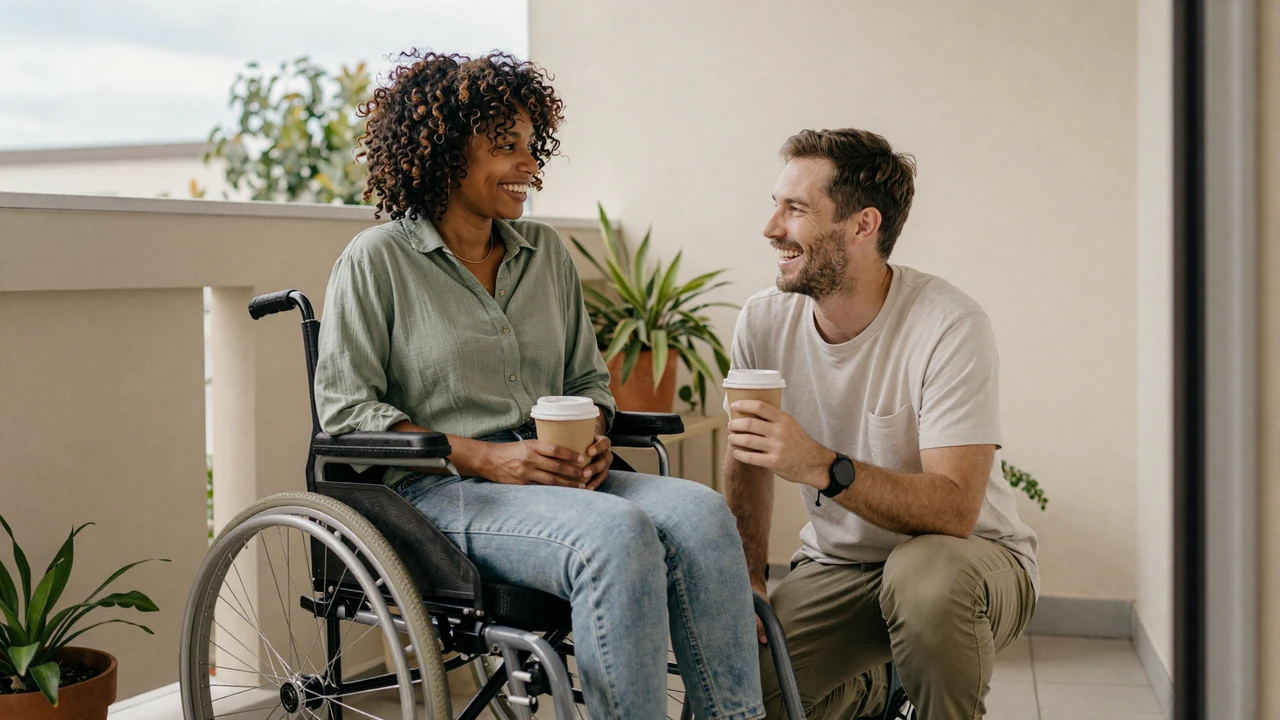
Interabled couple laughing together on a sunlit balcony - a wheelchair user with natural curls and her partner kneeling beside her sharing coffee, showing dating with a disability as joyful and real

The 5 myths we're busting

  • Myth 1: Disabled adults don't want romance or sex.
  • Myth 2: Dating a disabled person is "inspirational."
  • Myth 3: Disability equals asexuality.
  • Myth 4: A non-disabled partner is "settling."
  • Myth 5: Interabled relationships never last.

Each one gets a fact-checked reality below. Spoiler: the data does not support the stereotypes.

The evidence

What the data actually says

Before we touch a single myth, here are three numbers worth keeping in mind. Each one contradicts a stereotype that mainstream dating culture still repeats out loud.

2 in 3 Working-age disabled adults report severe loneliness Brown University, 2025
1.3B People worldwide live with significant disability World Health Organization, 2024
71% Of disabled daters have left a mainstream app over ableism or fetishization Modern Dating community survey, 2026

The Brown University finding matters most. Loneliness on that scale is not a personality trait of disabled people - it is the cumulative effect of being told, year after year, that you don't belong in love stories.

Myth 01

Disabled adults don't want romance

This is infantilization in a sentence, and it shapes everything from parental attitudes to healthcare intake forms.

The myth

Disabled people - especially those with developmental or intellectual disabilities - are pictured as perpetual children. The assumption is that they do not feel, should not act on, and cannot responsibly handle romantic or sexual desire. Parents police dating. Group homes restrict privacy. Doctors skip the sexual-health conversation entirely.

The reality

Disabled adults date, fall in love, choose casual hookups, choose monogamy, choose open relationships, marry, co-parent, and divorce at rates that look a lot like the general population when they are given access. What changes the statistics isn't desire - it's opportunity. Remove infantilization and the "disinterest" disappears.

See our Down syndrome dating and autistic dating pages for community-led, consent-centered dating frameworks that refuse the infantilization script.

Myth 02

Dating a disabled person is inspirational

The late disability advocate Stella Young called it "inspiration porn." It is the single most exhausting compliment a disabled dater can receive.

The myth

A non-disabled partner who dates a disabled person is doing something brave, saintly, or selfless. The relationship becomes a moral achievement - fodder for viral videos, Facebook captions, and wedding toasts that talk about the partner "choosing" love "despite" disability.

The reality

Disabled people are not a character-building experience. Healthy partners don't date disability; they date a person. Fetishizing the "despite" reduces both people to stereotypes and, as most disabled daters will tell you, is a reliable early warning of a partner who will eventually ghost or worse. Real love is not a fundraiser.

The second someone calls you "inspiring" on a first date, you are no longer a person. You are their personal growth arc. - Modern Dating community member, 2026
Myth 03

Disabled people are asexual

This one gets dressed up as politeness, but it is still erasure.

The myth

Bodies that move, feel, or look different are assumed to be bodies that can't or don't want sex. Wheelchair users are pictured as sexless. Autistic adults are called "robotic." Little people are cast as cute. The assumption is so universal that disabled people often have to come out as sexual, the way queer people come out as queer.

The reality

Disability and sexuality are independent variables. Some disabled people are asexual - and that is valid on its own terms, not because of disability. Most are not. Attraction, desire, kink, and romance exist across every body and every brain. Equating disability with asexuality is the same tired gatekeeping the queer community spent decades dismantling.

Myth 04

Non-disabled partners are settling

The flip side of inspiration porn - and often said by the same people.

The myth

A non-disabled person in an interabled relationship is "settling," lowering their standards, or couldn't find someone "better." The disabled partner, in this story, is a consolation prize that the able-bodied partner will eventually outgrow.

The reality

Partners choose each other for reasons the outside world rarely sees - shared humor, emotional fluency, sexual chemistry, values, steadiness in a crisis. Disability can shape how a relationship runs logistically without affecting why two people want to keep running it. Calling that "settling" says more about the speaker's imagination than the couple's life.

If you're navigating this dynamic, our partner expectations guide and interabled dating page go deeper.

Myth 05 · Reality check

Interabled relationships: the real picture

The fifth myth - that interabled couples never last - collapses the minute you spend five minutes with an actual interabled couple. Here are two voices from our community who are tired of being told their love is a temporary arrangement.

“I became disabled at 55 after a bike crash and stayed single for eight years. I met Howard on Dateability. When I needed surgery in March, he flew out and took care of me. He has Parkinson's; I have a sitting disability. He drives, I cook. We don't complete each other - we complement each other, and that is a much better deal.”

Leslie, 63 Interabled couple, California · Met on a disabled dating site

“People act like my husband settled because I use a chair. He didn't settle. He won. I'm funnier than him, I cook better than him, and I've been through hell and came out steady. Disability did not subtract from me. It just filtered out the people who were never going to show up anyway.”

Priya, 38 Wheelchair user, seven years married

What actually threatens interabled relationships is not disability itself - it is ableism leaking in from outside: unsolicited opinions from family, inaccessible social events, healthcare systems that treat the disabled partner as a patient first and a spouse second. Couples who name that pressure out loud and push back on it together tend to do fine. Couples who pretend it isn't there don't.

The Brown 2025 data cuts both ways here. Yes, two-thirds of disabled adults report severe loneliness. That's the bad news. The good news is that the loneliness is a function of access, not of desire or capacity. Give disabled daters a platform built for them, a respectful partner pool, and room to move at their pace, and the story bends quickly toward connection. That is the whole premise of a disabled dating site done right.

More reading

If this piece landed, these three go deeper into the craft of finding love with a disability.

Story

Real stories of disabled couples

Leslie & Howard, Kaci & Collin, and more - long-form accounts of how couples met, moved through disclosure, and built something durable.

Long readsInterabled
Read the stories
Confidence

Confidence and self-acceptance

Internalized ableism, body image after diagnosis or injury, and how to write a profile from strength instead of apology.

Internalized ableismProfile craft
Read the guide
Compatibility

Emotional compatibility

Why emotional fluency beats swipe mechanics for disabled daters, with signs, red flags, and a slow-burn connection playbook.

Slow burnGreen flags
Read the guide

Meet people who see you clearly

No inspiration porn. No infantilization. No asexuality assumption. A disabled dating site where finding love with a disability is the plot, not a plot twist.

See How It Works

Free to join. No credit card required. Move at your pace.